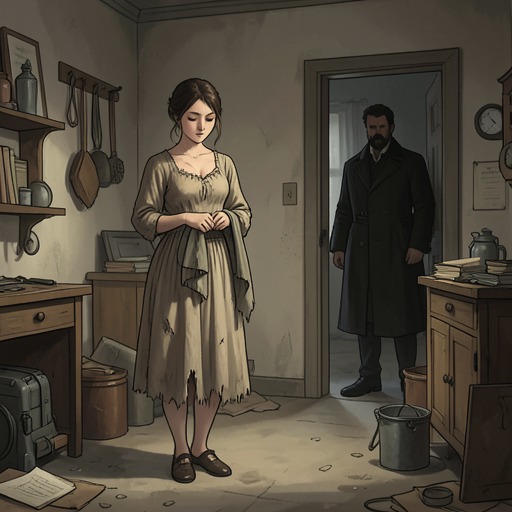
Boldwood
Far from the Madding CrowdBoldwood is a prosperous, unmarried gentleman-farmer near Weatherbury, first presented through the contrast between his reserved manner and the romantic story others imagine around him. Bathsheba Everdene’s Valentine, sent without a serious marriage intention, becomes for him the apparent beginning of a life-changing attachment; his response illustrates how a trivial gesture can acquire grave consequences when it is read as a promise.
Identity and Introduction
Boldwood lives at Little Weatherbury and is described as about forty, handsome, and stern-looking. He is also wealthy and respected, but his emotional reserve has made him an object of speculation among women in the surrounding district. Mrs. Coggan tells Bathsheba that many women have tried to win him without success, among them Jane Perkins, the Miss Taylors, and Farmer Ives’s daughter. This history establishes him as a man who has not responded to local courtship, rather than as someone already seeking a wife.
His concern for Fanny Robin reveals another aspect of his character. He had taken Fanny in when she had no friends in childhood, arranged for her education, and helped her obtain a place under Bathsheba’s uncle. When Fanny disappears, Boldwood asks whether there has been news of her. The farmworkers search for her, including dragging Newmill Pond, and Boldwood joins the effort; the report that Fanny may have followed her soldier sweetheart is sent to him as well. His interest in her welfare precedes his fixation on Bathsheba and shows a capacity for practical kindness.
Reserve and Romantic Projection
Bathsheba first encounters Boldwood indirectly, when he calls while she is too dusty to receive visitors. She asks who he is and learns that he is unmarried, well-off, and about forty. Later, after seeing him in town, she describes him to Liddy as handsome and upright, and remarks that he appeared not to notice her. When his carriage passes them, Boldwood keeps his eyes on the road and does not turn his head. His apparent indifference piques Bathsheba’s curiosity, and she and Liddy speculate that his reserve may result either from his nature or from an earlier romantic disappointment. The disappointment is only local rumor, not a confirmed fact; Bathsheba nevertheless finds the conjecture romantic.
That exchange foreshadows the different misreadings that will organize Boldwood’s relationship with Bathsheba. His reserved manner invites others to invent a history for him, while Bathsheba’s own playful actions are later invested with a seriousness she did not intend. The novel thus makes interpretation itself consequential: character and motive are not always as clear to observers as they imagine.
The Valentine and Its Consequences
On St. Valentine’s Day, Bathsheba sends Boldwood a card bearing the words “MARRY ME.” The gesture originates in thoughtlessness, but Boldwood does not know this. At supper, he places the Valentine on the mantelpiece above his time-piece, where the red seal catches his attention. He repeatedly looks toward it and imagines the words even when the card is too far away to read. In his grave, quiet household, the message seems to acquire a solemnity absent from its origin.
Boldwood treats the card as evidence of a deliberate proposal. He cannot imagine that its motive might be slight, and the possibility that Bathsheba has written without intending marriage does not occur to him. He carries the Valentine to his bedroom and places it by the looking-glass, remaining conscious of it even when he turns away. Its anonymous female handwriting becomes a focus for imagined intimacy: he wonders about the woman behind the writing and why she might have pictured him. The object does not merely attract his attention; it supplies the premise from which he constructs a future.
The consequences extend beyond Boldwood’s private hopes. When Bathsheba considers his offer, she recognizes that he is a well-to-do, respected, and conveniently situated man, and that marriage to him would be an appealing prospect by ordinary social and practical standards. She esteems and likes him, but does not want to marry him. At the same time, she feels that because she began the chain of events with the Valentine, honesty may require her to accept its consequences. Her reluctance and sense of responsibility pull in opposite directions, leaving the original joke with a moral weight neither party had first assigned to it.
Bathsheba’s Farm and the Marriage Question
Boldwood’s proposal confronts Bathsheba at a moment when she has recently taken charge of Weatherbury Upper Farm. At her first public accounting with the workers, she announces that she has dismissed the bailiff for theft and will manage the farm herself, with her own judgment and labor. She also promises to serve the workers fairly if they serve her well, insisting that being a woman does not mean she cannot distinguish good conduct from bad. Her authority is newly established, and its novelty has not yet worn off when she weighs Boldwood’s offer.
Marriage is therefore not only a question of affection. Boldwood’s wealth, standing, and proximity make him a suitable match by the neighborhood’s standards, while Bathsheba’s position as the farm’s mistress gives her a degree of independence she would risk changing. She can reason through the advantages of marrying him and still feel no desire to do so. The conflict exposes a gap between social calculation and personal consent: an offer can be eminently practical without being wanted.
Narrative Significance
Boldwood’s early presentation links kindness and reserve with a vulnerability to romantic idealization. His concern for Fanny is grounded in concrete past assistance; his interpretation of Bathsheba’s Valentine, by contrast, depends on a motive he cannot see and does not question. The contrast makes clear that his attention is not itself proof of mutual feeling, and that a sign’s effect may be far larger than the intention behind it.
Through Boldwood, the Valentine becomes an instrument of unintended consequence. Bathsheba’s brief, unserious act enters his orderly life as what appears to be a deliberate invitation, while his resulting expectation places pressure on her freedom to refuse. His story also intersects with Bathsheba’s struggle to remain both a self-governing farmer and a woman expected to consider marriage as a practical necessity. The character’s significance lies in that collision: a private misreading gathers force in a world where reputation, property, and marriage are closely entangled.